
In the SEA Lab, we are studying ways to harness and store energy from the ocean. We design and analyze systems ranging from wave energy converters and offshore wind turbines for energy generation to offshore hydrogen production for energy storage.
Offshore Energy
Relevant Publications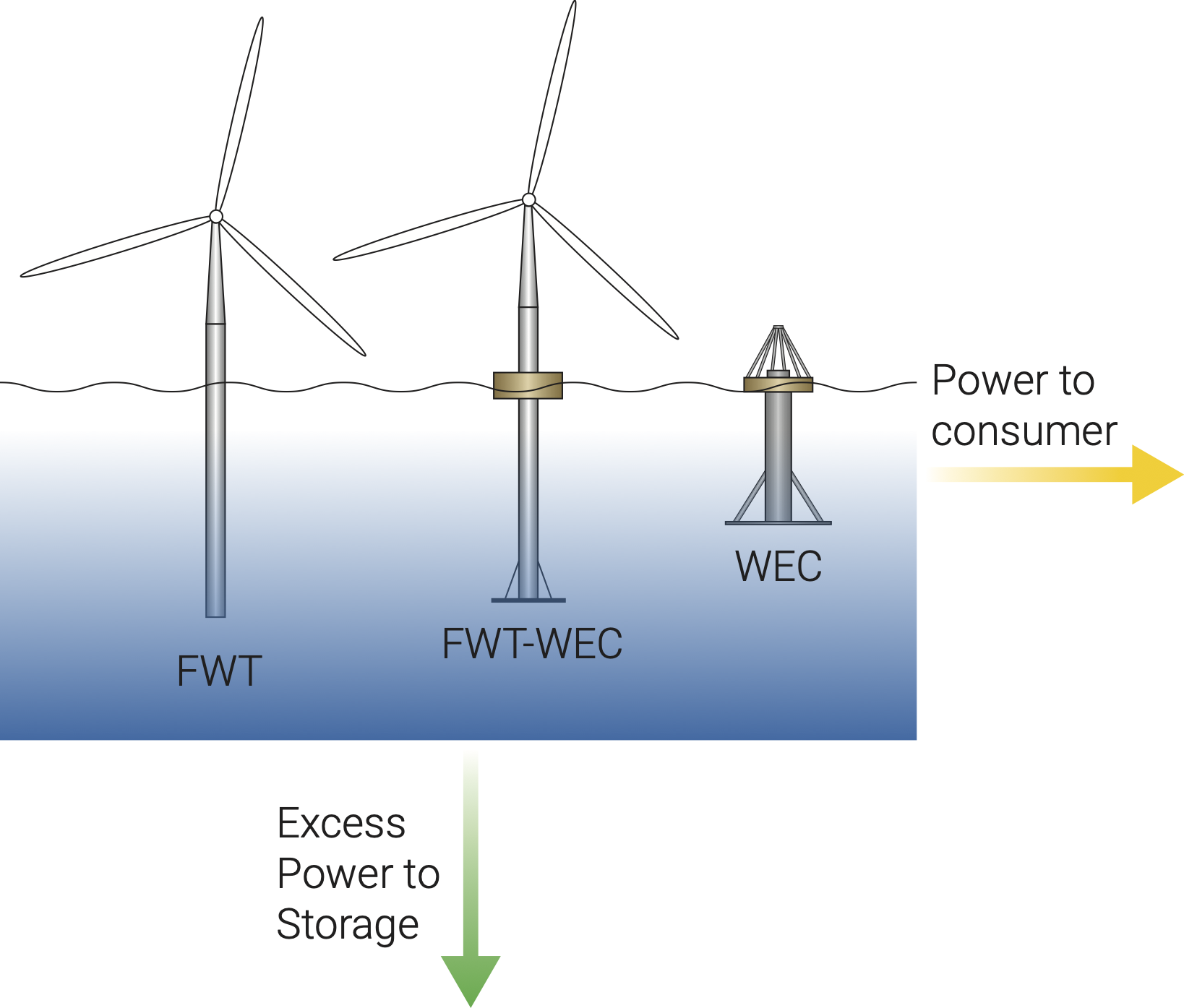
Wave Energy
Wave energy converters (WECs) remain expensive due to challenges in robustly converting time-varying stochastic waves to high-quality electricity, support frames that comprise up to 50% of the device mass, and low storm survivability. Research in the SEA Lab focuses on how to maximize the economic benefit of WECs by considering coupling them with other marine structures, such as offshore wind turbines, using them to generate electricity for smaller-scale systems, such as offshore aquaculture farms and autonomous underwater vehicle docking stations, or leveraging the high-pressure water generated by WECs for more efficient seawater desalination processes. Our group also investigates how wave energy can be incorporated into a mix of renewable energy assets as a means to provide grid stability.
O. Vitale, A. Ahmed, P. Lomonaco, M. N. Haji, HetWECs: Experimental heterogeneous wave energy converter arrays, Renewable Energy, Volume 274, 2026, 126162, ISSN 0960-1481, https://doi.org/10.1016/j.renene.2026.126162
K. Khanal, N. DeGoede, M. N. Haji, Multidisciplinary design optimization of wave energy converter farms considering uncertainty through polynomial chaos expansion, 2026, https://arxiv.org/abs/2607.10962, (in prep.)
R. McCabe, M. Dietrich, M. N. Haji, Development, validation, and benchmarking of a multidisciplinary semi-analytical model for wave energy converters, 2026, https://arxiv.org/abs/2606.22739, (in prep.)
O. Vitale, M. N. Haji, Wave energy converters as offshore wind farm guardians: a pathway to resilient ocean systems. Sci Rep 16, 26775 (2026). https://doi.org/10.1038/s41598-026-54843-z
Y. Bimali, R. McCabe, C. Treacy, K. Khanal, E. Lo, M. N. Haji, Matrix structure and convergence behavior of the matched eigenfunction method for computing heave wave forces on generalized concentric bodies, 2026, https://arxiv.org/abs/2605.19730, (in prep.)
N. DeGoede, M. N. Haji, Multidisciplinary design optimization for wave-driven desalination systems, Renewable Energy, Volume 276, 2026, 126339, ISSN 0960-1481, https://doi.org/10.1016/j.renene.2026.126339
O. Vitale, R. McCabe, A. Brundan, Y. Mandalam, A. S. A. Munera, M. N. Haji, Design, build, and analysis of small-scale wave energy converter prototypes, ASME Journal of Mechanical Design, 2026, 148(9): 091701, https://doi.org/10.1115/1.4070757
A. Ahmed, M. N. Haji, "Integrated Offshore Wind and Wave Energy: Dynamic Interactions and Economic Potential of Hybrid Systems." Proceedings of the ASME 2025 44th International Conference on Ocean, Offshore and Arctic Engineering. Volume 5: Ocean Renewable Energy. Vancouver, British Columbia, Canada. June 22–27, 2025. V005T09A077. ASME. https://doi.org/10.1115/OMAE2025-156296
N. GeGoede, M. N. Haji, "A Multidisciplinary Design Optimization Framework for Wave-Driven Desalination Systems." Proceedings of the ASME 2025 International Design Engineering Technical Conferences and Computers and Information in Engineering Conference. Volume 3B: 51st Design Automation Conference (DAC). Anaheim, California, USA. August 17–20, 2025. V03BT03A010. ASME. https://doi.org/10.1115/DETC2025-168312
R. McCabe and M. N. Haji, “Force-Limited Control of Wave Energy Converters using a Describing Function Linearization,” International Federation of Automatic Controls Conference, Blacksburg, VA, arXiv, 2024. Available: https://arxiv.org/abs/2409.02408.
K. Khanal, C. A. M. Ströfer, M. Ancellin, M. N. Haji, Fully differentiable boundary element solver for hydrodynamic sensitivity analysis of wave-structure interactions, Applied Ocean Research, Volume 163, 2025, 104707, ISSN 0141-1187, https://doi.org/10.1016/j.apor.2025.104707.
J. M. Kluger, M. N. Haji (co-first author), and A. H. Slocum, “The mechanical and supply-demand power balancing benefits of wave energy converters in combined offshore wind-wave and energy storage farms,” Applied Energy, 331, 120389, 2023. https://doi.org/10.1016/j.apenergy.2022.120389
Y. Q. Ang, A. Polly, A. Kulkarni, G. Bahl Chambi, M. Hernandez, and M. N. Haji, “Multi-objective optimization of hybrid renewable energy systems for a prototypical coastal community,” Renewable Energy, 201 (1), 72-84, 2022. https://doi.org/10.1016/j.renene.2022.09.126
K. Khanal, O. Vitale, N. DeGoede and M. N. Haji, “Multi-objective multidisciplinary optimization of wave energy converter array configurations and controls,” accepted to Second Annual University Marine Energy Research Community Conference, Durham, NH, October 4-6, 2023.
G. Ewig, A. Hasankhani, E. T. Won and M. N. Haji, “Marine spatial planning for siting wave-powered aquaculture farms,” accepted to Second Annual University Marine Energy Research Community Conference, Durham, NH, October 4-6, 2023. https://doi.org/10.5281/zenodo.10258027.
O. Vitale and M. N. Haji, “Effects of Wave Energy Converter Array Configurations and Geometries on Wave Field and Power Output,” International Design Engineering Technical Conferences & Computers and Information in Engineering Conference, Boston, MA, August 20-23, 2023. https://doi.org/10.1115/DETC2023-116472.
R. McCabe, M. Dietrich, A. Liu, and M. N. Haji, “System Level Techno-Economic and Environmental Design Optimization for Ocean Wave Energy,” International Design Engineering Technical Conferences & Computers and Information in Engineering Conference, Boston, MA, August 20-23, 2023. https://doi.org/10.1115/DETC2023-114607.
R. McCabe, O. Murphy, and M. N. Haji, “Multidisciplinary Optimization to Reduce Cost and Power Variation of a Wave Energy Converter,” International Design Engineering Technical Conferences & Computers and Information in Engineering Conference, St. Louis, MO, August 14-17, 2022. https://doi.org/10.1115/DETC2022-90227
M. N. Haji, J. M. Kluger (co-first author), T. P. Sapsis, and A. H. Slocum, “A Symbiotic Approach to the Design of Offshore Wind Turbines with Other Energy Harvesting Systems,” Ocean Engineering, 169, 673-681, 2018. https://doi.org/10.1016/j.oceaneng.2018.07.026
Hydrogen Production and Storage
The U.S. has announced a commitment to catalyze the deployment of offshore wind at scale, however the increased grid penetration of offshore wind energy requires the ability to deal with the variability of the wind energy output. One potential method of smoothing these variations is through the use of offshore wind energy to produce hydrogen at sea that can then be stored for later use in fuel cells. In the SEA Lab, we research the viability and economic opportunities of combining offshore wind with hydrogen production via electrolysis. Our group also investigates how production of hydrogen can be paired with passive mineral extraction to simultaneously harvest minerals such as lithium and cobalt from the oceans.